There are so many high annual fee credit cards out there these days that it can feel tempting or even necessary to get one in order to maximize value. But I strongly believe there are simple ways to keep your annual fees and net dollars out the door in check while still getting really great value.
In this article, I’m going to walk through one example around United miles and a little bit of cash back, which I’m sure is a popular stack for many folks, particularly near San Francisco, Newark, Chicago, or other United hubs.

Let’s start by saying that redeeming United miles directly through United gets you access to Saver awards, which is obviously ideal. That’s likely going to surpass the incremental points you might get from cards like the Amex Gold or Platinum with 4 to 5x returns on certain categories, especially if you’re redeeming through travel portals at lower point valuations.
Since you can’t always access United Saver awards through those portals, you lose a lot of that value. Additionally, those cards come with hefty annual fees, meaning you’re shelling out a lot and need to be very intentional about using all the credits and benefits to extract maximum value.
Let’s walk through a simple three card stack that can give you a great mileage setup, particularly if you’re a renter, while also earning some cash back with a 2 percent catch all card.
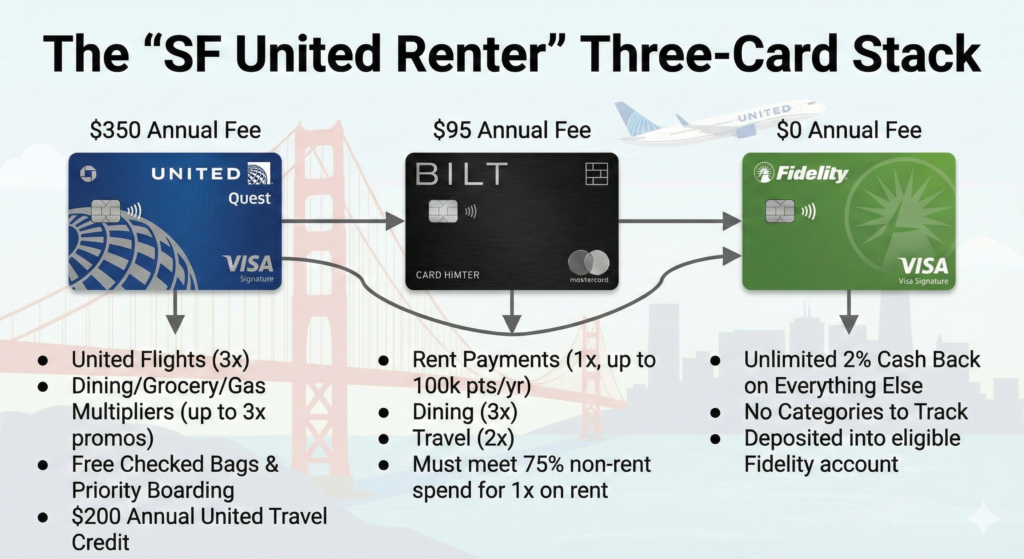
Let’s say you work in San Francisco, fly out of SFO, and are always on United. You obviously want to earn as many miles as possible without spending too much on annual fees. Here’s the three card stack:
- United Quest Card ($350 annual fee)
- Bilt Obsidian Card ($95 annual fee)
- Fidelity 2% Cash Back Card (no annual fee)
This is my everyday stack. It’s simple. The Quest card’s benefits can easily cover its annual fee, the out of pocket on the Bilt card is not too bad, and the Fidelity card has zero annual fee.
Let’s walk through how you can use each of these cards.
There’s been a lot of noise around the Bilt 2.0 rollout. Things can feel convoluted. But honestly, after running the numbers, I still felt compelled to get the card.
Let’s say you have a $2,500 rent payment. To earn 1x points on that rent spend, you need to meet Bilt’s minimum spend requirement of 75 percent of rent that amount, meaning you would need to spend over $1,875 per month on the Bilt card to ensure you’re earning points on the full $2,500 rent payment.
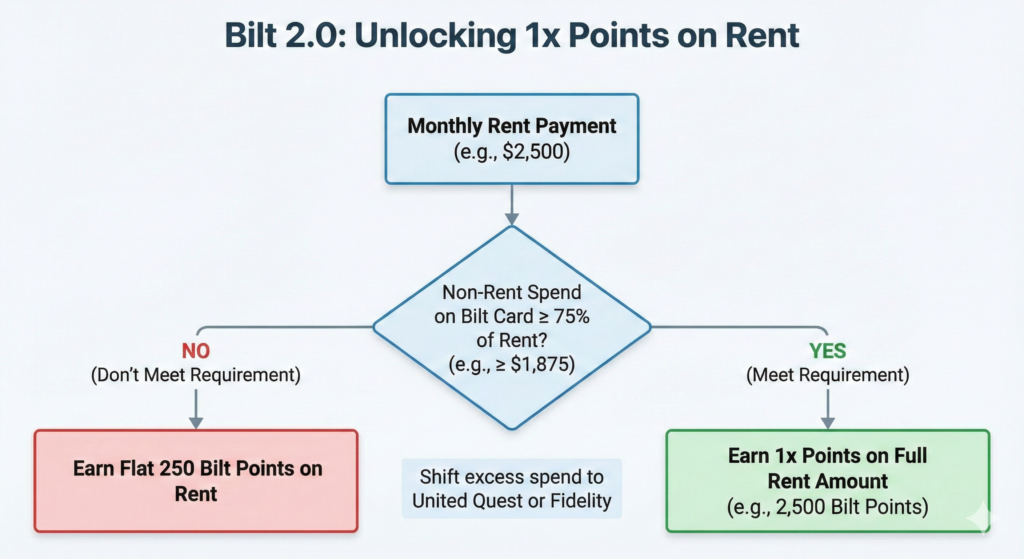
Once you hit that $1,875, you can shift additional spend over to the United Quest card. With the United Quest card, you’ll be able to access the many quarterly promotions that United runs, along with frequent multipliers, sometimes from 1x up to 3x, on gas stations, groceries, and restaurants, which they’ve run for several quarters in a row.
If they’re not running promotions or multipliers, you can continue using the Bilt card even after the $1,875 threshold, particularly for restaurant and grocery spend. Depending on how you structure your categories, you can earn 2 to 3x on much of your spend. For purchases that would otherwise fall into a flat 1 percent bucket with no multiplier, you can use the Fidelity 2% cash back card to earn a little cash back and still get solid value.
The benefit of this stack is that you get excellent return on your United miles, especially with promotions and multipliers, while keeping your out of pocket annual fees under $500, $445 total. In reality, with the United Quest’s $200 travel credit, 10,000 mile annual award bonus, and the ability to earn another 10,000 miles after $20,000 in annual spend, you’re not looking at much true net cost.
On the Bilt side, earning points on rent remains a uniquely valuable feature. A $2,500 monthly rent payment translates to roughly 30,000 points per year, which is meaningful mileage for spend you’re making anyway.
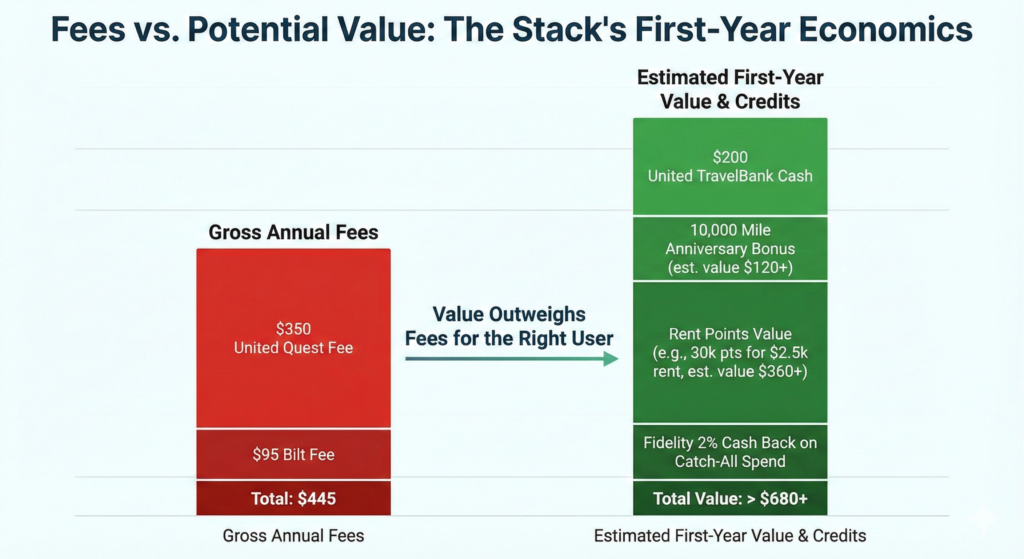
As you can see, the value is pretty clear. This isn’t even including additional things like free checked bags, Uber credits, hotel credits, and more that can come with both these cards.
It’s a strong overall stack, in one that is great for someone who wants clear, achievable goals and to not spend thousands of dollars in annual fees!